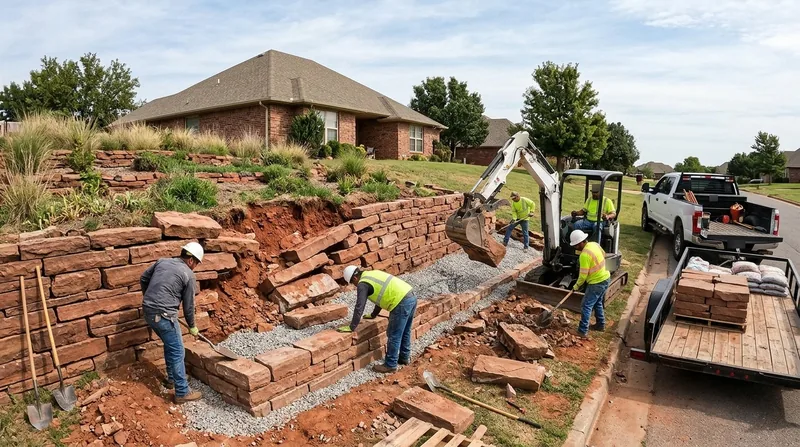




Retaining walls across Oklahoma City face relentless pressure from the region's expansive red Permian clay, which swells during wet spring storms and cracks during summer drought, combined with freeze-thaw cycles that crack mortar and push walls outward. A leaning and collapsed wall repair is often urgent: a wall that tilts inward or bulges outward signals hydrostatic pressure buildup, soil movement, or foundation failure that worsens weekly. Oklahoma City Retaining Wall responds quickly to stabilize failing walls across the metro area, from the brick Tudor homes of Mesta Park and Crown Heights to the postwar ranches and modern subdivisions spreading toward Edmond, Norman, and Moore. We use tieback anchors, drainage correction, and strategic rebuilds to stop the failure and restore safety and curb appeal. Call (405) 766-3551 for emergency assessment, or read on to understand what causes walls to fail here and how we fix them.
Why Retaining Walls Fail in Oklahoma City: Clay Swelling, Drainage, and Freeze-Thaw
Oklahoma City sits on gently rolling red-dirt prairie cut by creek ravines, and the dominant soil is expansive Permian clay that expands when saturated and contracts when dry. This cycle pushes against retaining walls from behind, especially during spring thunderstorms and after winter ice melt when groundwater pressure (hydrostatic load) builds up behind the wall. Most homeowners don't realize that a wall leaning inward or showing horizontal cracks is already under extreme stress. Poor or missing drainage behind the wall traps water, multiplying the outward force. Older walls built without proper backfill drainage, or walls installed on sloping terrain without interceptor swales, fail fastest.
- Expansive clay swells as it absorbs spring and winter moisture, pushing the wall outward and causing visible bulges or tilts.
- Hydrostatic pressure builds when drainage is blocked or absent, creating forces that exceed the wall's lateral resistance.
- Freeze-thaw cycles in Oklahoma winters crack mortar joints and dislodge stones, weakening the wall structure year after year.
- Inadequate backfill or compaction during original installation leaves voids that collect water and allow soil to shift.
- Tree roots or subsurface erosion near creek-bank walls (common in ravines along the North Canadian River and Deep Fork) undermine footings.
Understanding these failure modes is the first step to prevention and repair. Early intervention with drainage and anchoring can save a wall; delay often means full replacement.
Key info: A wall leaning more than one-half inch per foot of height is at risk of collapse. In Moore, Edmond, and Del City, we've seen 20+ year old segmental block and limestone walls fail within one season after a heavy spring thaw, because the original drainage stone was never installed or had settled and compacted. Get an assessment immediately if you notice new cracks, tilting, or bulging. See our drainage solutions page for more on preventing hydrostatic failure.
For permit and regulation details specific to your wall height and location, consult your local building department. Many Oklahoma City jurisdictions require a permit for walls above 4 feet measured from the footing, or when a wall supports a surcharge such as a driveway or structure. Engineered drawings may be required for tall or tiered walls. Always verify setback and property-line rules with your city or county before starting repair work.
How We Repair Leaning and Collapsed Walls: Assessment, Stabilization, and Rebuild
Our approach to leaning wall repair starts with a site visit to measure tilt, examine soil conditions, and identify the root cause (drainage, clay movement, footing failure, or load shift). We photograph the wall, probe the soil, and check for water seepage or subsurface erosion. Once we understand the failure mechanism, we choose the best stabilization method: tieback anchors to restrain outward movement, drainage correction to relieve hydrostatic pressure, or partial or full rebuild if the wall is structurally compromised beyond repair.
- We excavate behind the wall to expose the footing and backfill, removing saturated or compacted soil and assessing structural integrity.
- We install perforated drain pipe at the base of the wall, sloped to daylight or a sump, to intercept and redirect groundwater away from the wall.
- We place engineered drainage stone (typically 4 to 6 inches of #57 limestone) behind the wall to allow water to flow freely to the drain.
- For walls still tilting after drainage correction, we install tieback anchors (steel cables or rods anchored deep into stable soil) to pull the wall back to plumb.
- If the wall is cracked, displaced, or severely undermined, we remove and rebuild it using the original material or a compatible alternative, with proper drainage and compaction.
The entire process typically takes 3 to 5 days for a standard wall repair, longer if full rebuild is needed. We work carefully around landscaping and existing utilities, and we clean up debris daily.
Example from the field: A limestone ledge wall in Nichols Hills was leaning inward by 2 inches over 15 feet of height. The homeowner had water pooling at the base after heavy rains. We excavated, found the original backfill was clay with no drainage, installed a perforated drain and 6 inches of drainage stone, and anchored the wall with two tieback cables anchored 12 feet back into stable soil. The wall returned to plumb within 48 hours, and six months later, no new movement. Cost was $4,800 for labor, materials, and anchors.
Repair Methods: Tieback Anchors, Drainage, and Rebuild Options
| Approach | Description | Best for |
|---|---|---|
| Drainage Correction | Install perforated drain pipe and engineered backfill stone to intercept and redirect groundwater away from the wall footing. | Walls leaning due to hydrostatic pressure or saturated soil; often combined with anchoring for best results. |
| Tieback Anchors | Steel cables or rods anchored deep into stable soil behind the wall, tensioned to restrain outward movement and return the wall to plumb. | Walls leaning or bulging outward but structurally sound; avoids full demolition and rebuild. |
| Partial Rebuild | Remove the compromised upper section of the wall, rebuild with new material and proper drainage, then tie into the existing lower section. | Walls with cracked or displaced upper stones, or where the footing is sound but the superstructure is failing. |
| Full Rebuild | Demolish the entire wall, excavate and repair or reinforce the footing, rebuild with engineered drainage and proper compaction. | Walls with failed footings, severe subsurface erosion, or structural damage that cannot be anchored or partially repaired. |
Leaning and Collapsed Wall Repair Cost in Oklahoma City: What to Expect
The cost of leaning and collapsed wall repair in Oklahoma City depends on wall height, length, material, cause of failure, and whether the footing is salvageable. Drainage correction alone (excavation, drain pipe, and backfill stone) typically starts at $2,500 for a 20-foot wall section. Tieback anchoring adds $800 to $1,500 per anchor cable, depending on depth and soil conditions. Partial or full rebuild costs scale with wall area and material, ranging from $3,500 for a small section to $12,000 or more for a 40-foot wall rebuild. Always get 2 to 3 estimates from licensed contractors, because soil conditions and hidden damage vary site to site.
Travel to your home is included in our service area (Oklahoma City, Edmond, Norman, Moore, Midwest City, Del City, Yukon, Mustang, Bethany, Warr Acres, The Village, Nichols Hills, Choctaw, Newcastle, Guthrie, and Harrah). Free estimates are available within 24 hours; call (405) 766-3551 to schedule. Visit our full pricing page for a detailed breakdown of labor, materials, and typical project costs by scope.
Leaning and Collapsed Wall Repair Near Me: What Oklahoma City Homeowners Should Know When Hiring a Contractor
Choosing the right contractor for wall repair is as important as the repair itself. Look for a company that is licensed and insured, responds quickly to emergency calls, and provides a written estimate that itemizes labor, materials, drainage, and any engineered work. Ask for references from recent jobs in your neighborhood (Mesta Park, Crown Heights, Heritage Hills, or newer subdivisions all have different wall types and failure patterns). Verify that the contractor understands local permit requirements, because many Oklahoma City jurisdictions require a permit for walls above 4 feet or when a wall supports a surcharge. If your wall is in an HOA community, confirm that HOA approval is in place before starting work.
- Ask the contractor to explain the cause of your wall failure and why their repair method will prevent it from happening again.
- Confirm that the contractor carries general liability and workers compensation insurance, and ask to see certificates before signing a contract.
- Get at least two independent estimates so you can compare methods, materials, and pricing and make an informed decision.
- Check references from homeowners in Oklahoma City or nearby areas who had similar walls repaired within the last two years.
- Request a written warranty on labor and materials (typically one year for drainage and anchoring, three years for rebuild work).
Contact us today for a free assessment and estimate, or call (405) 766-3551 to speak with a repair specialist.
Leaning & Collapsed Wall Repair in Oklahoma City: Pricing Guide
| Service | Price | Details |
|---|---|---|
| Drainage correction (excavation, drain pipe, backfill stone) | Starting at $2,500 | Includes site prep, perforated drain installation, engineered backfill, and cleanup for a 20-foot wall section |
| Tieback anchor stabilization (per cable or rod) | Starting at $800 | Includes anchor installation, tensioning, and testing; cost varies with anchor depth and soil conditions |
| Partial wall rebuild (upper section) | Starting at $3,500 | Includes selective demolition, footing assessment, material, and reinstallation with drainage; price scales with wall height and length |
| Full wall rebuild (complete removal and replacement) | On estimate | Requires site assessment to evaluate footing damage, subsurface erosion, and material choice; complexity and material selection drive final cost |
| Travel and site assessment | Included | No mileage fee or call-out charge within Oklahoma City metro area and surrounding service cities |
| Free estimate and emergency response | Free | 24-hour response for emergency wall failures; written estimate includes all labor, materials, and warranty detail |
Indicative pricing, the exact cost depends on square footage, finish, and site access. Free personalized estimate within 24h at (405) 766-3551.


