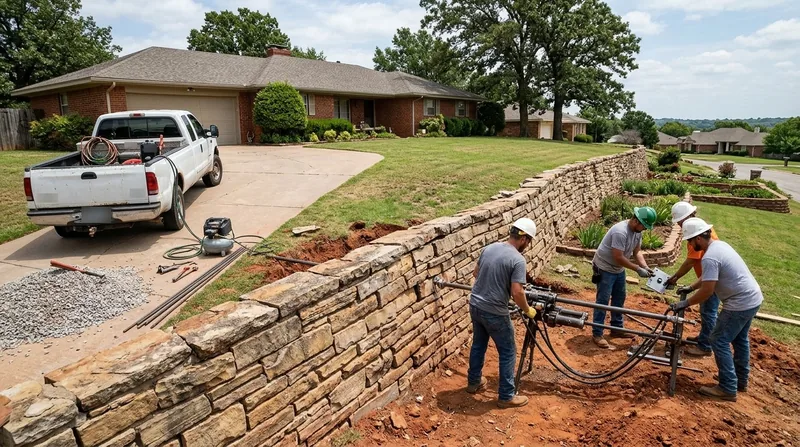




Retaining Wall Repair in Oklahoma City is not optional when your wall begins to lean, bow, or crack. The red Permian clay that underlies Oklahoma City swells and shrinks with every dry spell and spring thunderstorm, putting enormous lateral pressure on walls built decades ago. Combined with freeze-thaw cycles, flash flooding along the North Canadian River and its tributaries, and the weight of driveways or structures bearing down from above, even well-built walls fail. We stop that failure before the next big rain finishes the job, using drainage correction, tieback anchors, partial rebuilds, and engineered solutions tailored to the wall's material and the soil pushing against it.
Why Retaining Wall Repair Matters in Oklahoma City
A failing retaining wall is not cosmetic. It signals that soil pressure, water infiltration, or settlement is winning, and the wall will not hold much longer. In Oklahoma City, the problem is usually one of three things: expansive clay that swells and cracks between drought and downpour, poor or failed drainage allowing water to accumulate behind the wall, or a wall that was never designed for the load it now carries. Homes in Heritage Hills, Mesta Park, Crown Heights, and the newer subdivisions stretching into Edmond, Norman, and Moore all rely on retaining walls to hold back slopes, contain driveways, and protect foundations. When those walls lean or settle, the cost of delay is far higher than the cost of repair.
- We assess the cause of failure, whether expansive clay, poor drainage, or structural overload.
- We install or repair underdrain systems to redirect water away from the wall and reduce hydrostatic pressure.
- We anchor leaning walls with tieback cables or helical anchors driven deep into stable soil.
- We rebuild sections of wall that cannot be salvaged, using the same material or upgrading to a more durable alternative.
- We verify that the repaired wall complies with Oklahoma City building code and any local setback or easement rules.
Early repair prevents catastrophic failure and protects the property and structures behind the wall.
Key info: A wall leaning more than half an inch per foot of height, or showing horizontal cracks wider than 1/8 inch, is in active failure and should not wait for spring. In Oklahoma City, the freeze-thaw cycle between December and March is often the final blow. Call us immediately at (405) 766-3551 if your wall is moving.
For more information on permitting and building code thresholds in Oklahoma City, consult the Oklahoma City Development Services Building Permits page, which specifies when engineered drawings and permits are required for walls above 4 feet.
How We Repair Retaining Walls in Oklahoma City: Our Process
Every repair starts with a site inspection and diagnosis. We measure the wall, check for signs of movement, probe the soil behind it, and look for drainage failures or structural issues. Once we understand what failed and why, we develop a repair plan that stops the failure and restores stability. Some repairs are simple drainage fixes; others require anchoring or partial rebuilds. We explain the options and the cost before we start work.
- We excavate around the wall to expose the footing, assess soil conditions, and check for water infiltration or settlement.
- We install or repair underdrains, perforated pipe, and gravel backfill to remove water pressure and improve drainage behind the wall.
- We anchor leaning walls using tieback cables, helical anchors, or soil nails driven into stable soil at depth.
- We rebuild any sections of wall that cannot be stabilized, matching the original material or upgrading to concrete or block if timber or stone is no longer viable.
- We backfill with compacted soil and gravel, re-establish drainage, and test the wall for plumb and stability before we leave the site.
The entire process takes 3 to 5 days for most repairs, depending on wall size and access. For details on material options and long-term durability, see our guide to Concrete Retaining Walls and Retaining Wall Drainage.
Local example: A limestone ledge wall in Nichols Hills was leaning 2 inches at the top after three years of drought followed by record spring rains. The soil behind it was saturated and expanding. We excavated, installed a 4-inch perforated underdrain with gravel backfill, and anchored the wall with three tieback cables at 8-foot intervals. The wall is now plumb, and water no longer pools behind it. Total time: 4 days.
Repair Methods and When to Use Each One
| Approach | Description | Best for |
|---|---|---|
| Drainage Repair | Install or replace perforated underdrain pipe, remove standing water, and re-grade soil to shed water away from the wall. | Walls that are leaning slowly or showing minor cracks due to water pressure buildup behind the wall. |
| Tieback Anchors | Drive steel cables or helical anchors deep into stable soil behind the wall and anchor them to the wall face to resist lateral pressure. | Walls leaning 1 to 3 inches, or walls that cannot be removed without major excavation or property damage. |
| Partial or Full Rebuild | Remove the failed or unstable section of wall and rebuild it with new material, proper footing, and engineered backfill. | Walls with severe cracks, settlement, or failed mortar that cannot hold water or soil pressure any longer. |
| Soil Nails and Geotextile | Drive steel nails through the wall face into stable soil, and install geotextile fabric to improve internal stability and reduce seepage. | Walls in sandy or loose soil where conventional anchoring alone is not enough to prevent progressive failure. |
| Material Upgrade | Replace aging timber, railroad ties, or failing stone with engineered concrete or segmental block that will outlast the original wall. | Timber and railroad tie walls that are rotting or have shifted, or stone walls with failed mortar and poor drainage. |
The right repair method depends on the wall's age, material, the cause of failure, and whether you want to preserve the original appearance or upgrade for durability. We recommend a site visit and estimate before you decide.
Retaining Wall Repair Cost in Oklahoma City: What to Expect
Retaining wall repair costs in Oklahoma City range from $1,500 for drainage fixes on small walls to $8,000 or more for anchoring or partial rebuilds on tall or complex structures. The price depends on four main factors: the length and height of the wall, the cause and extent of failure, access and site conditions, and whether you need engineered drawings or a permit. A 20-foot wall that needs only drainage repair and backfill might cost $2,500 to $4,000. The same wall that requires tieback anchors or a section rebuild could run $5,000 to $10,000. A full replacement of a failed wall is a separate project, and we handle that too.
We always provide a free estimate after a site inspection. We measure the wall, assess the soil and drainage, check for settlement or movement, and explain what needs to be done and why. We also tell you upfront if your wall requires a permit from the Oklahoma City Development Services or a neighboring jurisdiction like Edmond, Norman, or Moore. Some walls do, some do not, depending on height and property-line setbacks. Getting 2 or 3 estimates is smart, because repair methods and material choices can affect cost significantly. For a detailed pricing breakdown, see our full pricing page.
Retaining Wall Repair Near Me: What Oklahoma City Homeowners Should Know When Hiring
Hiring the right contractor for retaining wall repair is critical. The wrong choice can leave you with a wall that fails again in a few years, or worse, damage to your property or a neighbor's. When you call a contractor, verify three things: licensing and insurance, experience with the type of wall you have, and a willingness to get a permit if required. Oklahoma City and surrounding areas like Edmond, Norman, and Moore all have building codes and setback rules that apply to retaining walls above 4 feet. A licensed contractor will know those rules and pull permits if needed. An insured contractor protects you if something goes wrong on the job.
- Ask to see a current business license and proof of general liability and workers compensation insurance before you hire.
- Request references from three recent retaining wall repair jobs in Oklahoma City, Edmond, Norman, or Moore, and call them.
- Confirm that the contractor understands local building code and will coordinate with the city or your jurisdiction if a permit is needed.
- Get a written estimate that lists the work to be done, the materials to be used, the timeline, and the total cost with no hidden fees.
- Ask whether the repair includes a warranty on labor and materials, and for how long the contractor stands behind the work.
- Verify that the contractor has experience with the specific material of your wall, whether it is limestone, concrete, block, timber, or railroad ties.
Call us at (405) 766-3551 for a free estimate, or visit our contact page to request an inspection and quote.
Retaining Wall Repair in Oklahoma City: Pricing Guide
| Service | Price | Details |
|---|---|---|
| Drainage Repair | Starting at $1,500 | Includes underdrain installation, gravel backfill, and site re-grading to remove water pressure behind wall |
| Tieback Anchoring | Starting at $3,500 | Anchors leaning walls using steel cables or helical anchors; cost increases with wall height and number of anchors needed |
| Partial or Full Wall Rebuild | Starting at $4,500 | Removal and reconstruction of failed wall sections using concrete, block, or stone; price depends on length, height, and material choice |
| Material Upgrade (Timber to Concrete) | Starting at $5,000 | Replace aging timber or railroad tie walls with engineered concrete or segmental block for permanent durability |
| Complex or Multi-Method Repair | On estimate | Combination of drainage, anchoring, and rebuild on tall or severely failed walls requires site inspection and engineered design |
| Free Estimate and Site Inspection | No charge | Response within 24 hours at (405) 766-3551; includes diagnosis, repair options, and written cost estimate before any work begins |
Indicative pricing, the exact cost depends on square footage, finish, and site access. Free personalized estimate within 24h at (405) 766-3551.


