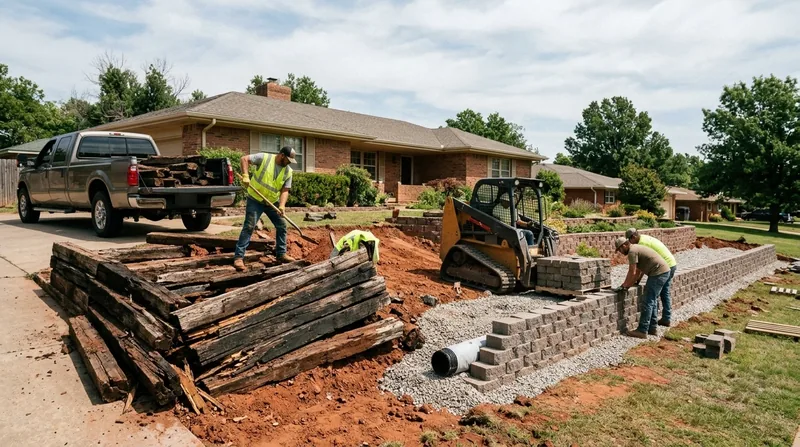




Railroad Tie Wall Replacement in Oklahoma City addresses one of the most common landscape failures across the metro area: aging creosote-treated timber borders that buckle, rot, and collapse under the pressure of Oklahoma's red clay soil and freeze-thaw cycles. Homes built in the 1970s, 80s, and 90s across neighborhoods from Heritage Hills to Moore and Edmond often rely on railroad tie retaining walls that have now reached the end of their service life. These walls fail fast because the expansive Permian clay beneath them swells during spring rains and summer thunderstorms, then contracts sharply during drought, cracking the ties and destabilizing the structure. Winter ice and the bright prairie freeze-thaw cycle accelerate decay from the inside out. When a railroad tie wall leans, bows, or shows visible rot and separation, replacement is not optional. We remove the failed structure, haul away the creosote-treated material responsibly, install proper drainage and gravel backfill, and rebuild the wall in durable block, poured concrete, or local stone that will hold for decades. This page covers what drives railroad tie wall failure in Oklahoma City, how we execute the replacement, what to expect in cost and timeline, and how to choose a contractor you can trust.
Why Railroad Tie Walls Fail in Oklahoma City: The Red Clay Problem
Oklahoma City sits on gently rolling red-dirt prairie cut by the North Canadian River and wooded creek ravines, where the soil is dominated by expansive Permian clay. This clay is the enemy of railroad tie retaining walls. When spring thunderstorms dump rain or the North Canadian rises after heavy flow, that clay swells dramatically. When drought returns and the prairie dries under the bright Oklahoma sun, the clay shrinks and cracks. Railroad ties, already weakened by decades of creosote treatment breakdown and exposure to moisture, cannot withstand this cyclical pressure. The wood splits, the ties separate from one another, and the wall bows outward or collapses entirely.
- Expansive red clay swells and contracts with seasonal moisture, pushing ties apart and cracking the wood from within.
- Freeze-thaw cycles in winter cause water trapped in the soil to expand, heaving the wall and breaking tie-to-tie connections.
- Creosote preservative degrades over 25 to 30 years, leaving the wood vulnerable to rot and insect damage.
- Poor or absent drainage behind the wall allows standing water to saturate the clay and the ties simultaneously, accelerating failure.
- Heavy spring runoff and flash flooding from creek systems like Deep Fork and Crutcho Creek overwhelm undersized drainage, destabilizing the base.
These failure modes are specific to Oklahoma City's climate and geology, and they demand immediate action when visible.
Key info: A leaning or bowing railroad tie wall in Oklahoma City is not a cosmetic problem. It signals that the clay beneath has begun to fail, and collapse can happen suddenly, especially after heavy rain or during spring thaw. Homeowners in Edmond, Norman, Moore, and throughout the metro should have any visible bow, separation, or rot evaluated immediately. See our leaning and collapsed wall repair service for emergency assessment.
For regulatory and permit guidance specific to Oklahoma City, consult the City of Oklahoma City Planning Department, which enforces building code thresholds for retaining walls above 4 feet or supporting surcharges such as driveways or structures.
How We Execute Railroad Tie Wall Replacement in Oklahoma City
Our process is straightforward: we assess the failed wall on site, plan the replacement material and drainage strategy, remove and haul the creosote-treated ties responsibly, prepare the base and install new gravel backfill with proper perimeter drainage, and rebuild the wall to code and grade. We work with the local building departments to verify permit requirements, which vary by city and wall height. Once we know what we are working with, the job moves fast and clean.
- We inspect the failed wall, measure the footprint, and assess soil conditions and drainage requirements on your property.
- We obtain any required permits from the City of Oklahoma City, Edmond, Moore, or the relevant local jurisdiction.
- We excavate the base, compact the soil, and install a gravel bed with perimeter drainage to prevent water from pooling behind the new wall.
- We build the new wall in your choice of segmental block, poured concrete, or local stone, set to proper grade and alignment.
- We backfill with compacted gravel and native soil, slope the surface for drainage, and finish the site so it looks intentional and clean.
Total timeline depends on wall size and material choice, but most single-wall replacements complete in 3 to 7 working days.
Local example: A homeowner in Mustang had a 40-foot railroad tie wall along a sloped driveway that had begun to bow outward in 2023. We removed the ties, installed 4 inches of gravel base with a perforated drain line, and rebuilt the wall in gray segmental block that matched the stone ledges visible in the Cross Timbers hills to the northeast. The job took 5 days, and the new wall has handled two spring thaw cycles without movement.
For more details on retaining wall replacement in general, see our retaining wall replacement service page.
Replacement Material Options: Block, Concrete, or Stone
When a railroad tie wall fails, you have three primary paths forward. Each offers different durability, aesthetics, and cost profile. We recommend the option that best matches your soil conditions, drainage needs, budget, and the character of your neighborhood.
| Approach | Description | Best for |
|---|---|---|
| Segmental Block (SRW) | Interlocking modular blocks, typically 12 to 18 inches wide, stacked with a slight batter (backward lean). No mortar required. Absorbs minor settlement without cracking. | Residential slopes up to 12 feet, expansive clay soils, areas where slight movement is expected. Common in Moore, Edmond, and newer subdivisions. |
| Poured Concrete | Monolithic reinforced concrete wall, typically 8 to 12 inches thick, set on a concrete footing below frost line. Rigid and permanent. Requires proper drainage or will trap water and crack. | High-traffic areas, tight spaces, or where a solid barrier is required. Durable in Oklahoma freeze-thaw cycles if drainage is correct. Common along creek banks and driveways in Del City and Midwest City. |
| Local Stone (Ledge or Boulder) | Red and brown sandstone or limestone ledge, dry-stacked or mortared. Matches the natural rock visible in Cross Timbers hills and creek ravines. High aesthetic value and proven longevity in Oklahoma. | Heritage neighborhoods like Heritage Hills and Mesta Park, or any property where natural appearance and permanence matter. Expensive but timeless. Handles clay movement better than concrete. |
| Timber Replacement (Non-Railroad Tie) | Pressure-treated landscape timber or composite lumber, typically 6x8 or 8x8, installed with proper drainage and geotextile. Modern pressure treatment lasts 15 to 25 years, longer than creosote ties. | Lower budget, aesthetic preference for wood, or temporary solutions. Not recommended as permanent replacement in expansive clay without robust drainage and tie-back anchors. |
We recommend segmental block or local stone for most Oklahoma City properties, because both handle the expansive clay and freeze-thaw cycles better than poured concrete or new timber. See our block retaining wall service and boulder and natural stone wall service for details on each.
Railroad Tie Wall Replacement Cost in Oklahoma City: What to Expect
Railroad tie wall replacement in Oklahoma City typically starts at $35 per square foot for segmental block on a standard residential slope with good access and minimal drainage complexity. That figure assumes a wall 4 to 8 feet tall, straightforward excavation, and standard backfill. Cost moves up based on several concrete factors: wall height (every foot above 8 feet adds structural complexity and material), total linear footage, soil conditions (poor drainage or highly expansive clay requires more extensive base prep), access (if equipment cannot reach the site easily, labor and hauling costs rise), and material choice (local stone costs more than block, but lasts longer in Oklahoma's climate). A 60-foot wall 6 feet tall in block runs roughly $12,600 to $15,000. A similar wall in local stone may run $18,000 to $24,000. Poured concrete falls in the middle, around $14,000 to $18,000, depending on reinforcement and finish.
We always recommend getting two to three estimates from licensed contractors in the Oklahoma City area. Each site has unique drainage and soil conditions, and a thorough on-site assessment is the only way to give you an honest number. Our estimate is free and comes with no obligation to book. Call us at (405) 766-3551 and we will schedule a walk-through within 24 hours. See our full pricing page for more detail on what drives cost in your specific situation.
Railroad Tie Wall Replacement Near Me: What Oklahoma City Homeowners Should Know When Hiring a Contractor
Hiring the right contractor for railroad tie wall replacement is as important as choosing the material. A cheap estimate from an unlicensed operator may leave you with poor drainage, a wall that fails again in five years, or liability if the wall collapses and damages a neighbor's property. Here is what to check before you sign a contract.
- Ask for references from at least three completed retaining wall jobs in Oklahoma City, Edmond, Moore, or nearby cities, and call them.
- Confirm that the contractor understands local permit requirements for your city and will handle permit applications if needed.
- Discuss drainage strategy explicitly. Poor drainage is the number one cause of wall failure in Oklahoma clay. Ask how they plan to manage water behind the wall.
- Get the estimate in writing, including material choice, wall dimensions, site prep, and any contingencies if soil conditions change during excavation.
- Check whether your homeowners association or neighborhood has design guidelines for retaining walls, and confirm the contractor will comply.
We handle all permit coordination with the City of Oklahoma City and surrounding jurisdictions. When you call us at (405) 766-3551, you speak to someone who has walked the red clay and Cross Timbers terrain and knows what works. Contact us for a free estimate today.
Railroad Tie Wall Replacement in Oklahoma City: Pricing Guide
| Service | Price | Details |
|---|---|---|
| Segmental Block Wall Replacement | Starting at $35/sq ft | Includes demolition, gravel base, drainage, and block installation. Cost rises with wall height, linear footage, and soil prep complexity. |
| Poured Concrete Wall Replacement | Starting at $40/sq ft | Includes footing excavation, reinforcement, concrete pour, and backfill. Higher cost reflects labor and material for permanent monolithic structure. |
| Local Stone or Ledge Wall Replacement | Starting at $50/sq ft | Includes stone sourcing, setting, and pointing. Premium pricing reflects material cost and skilled labor for dry-stack or mortared finish. |
| Complex or large-scale replacement | On estimate | Multi-tiered walls, steep slopes, poor access, or engineered design for tall walls require on-site assessment before pricing. |
| Travel and site visit | Included | No separate mileage or travel charge for Oklahoma City and surrounding service areas. Free estimate within 24 hours. |
| Free estimate and design consultation | No obligation | Call (405) 766-3551. We assess the failed wall, discuss material options, and provide a written quote with no pressure to book. |
Indicative pricing, the exact cost depends on square footage, finish, and site access. Free personalized estimate within 24h at (405) 766-3551.


