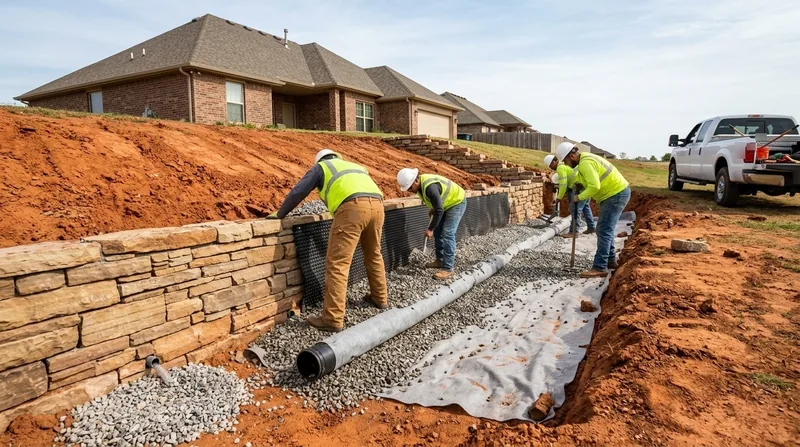




Oklahoma City's retaining walls face a relentless enemy: water. The red Permian clay that underlies most of the metro area swells when wet and shrinks when dry, creating massive hydrostatic pressure behind walls during the spring thunderstorm season and after winter freeze-thaw cycles. Retaining wall drainage in Oklahoma City is not a luxury, it is the single most effective defense against wall failure, bulging, and collapse. Without proper drainage, even a well-built wall in Edmond, Norman, or Moore will eventually fail. We install French drains, weep holes, gravel backfill systems, and waterproofing membranes that intercept water before it builds pressure behind your wall. The result is a wall that stays plumb, stays intact, and lasts decades instead of years.
Why Retaining Wall Drainage Fails in Oklahoma City's Red Clay
Oklahoma City sits on expansive clay that moves with moisture. When heavy rain or snowmelt saturates the soil behind a retaining wall, hydrostatic pressure builds up. That pressure pushes the wall outward. If water cannot escape, the wall bulges, cracks, leans, and eventually collapses. This is the dominant failure mode across Oklahoma City, from Heritage Hills and Mesta Park to the newer subdivisions in Yukon and Mustang. Winter ice lenses add to the problem, freezing water in the soil and expanding it further. Without drainage relief, a wall that looks solid today may be bowing dangerously by spring.
- Hydrostatic pressure builds when water saturates clay soil behind the wall and has no outlet.
- Spring thunderstorms and winter thaw cycles create the highest-risk periods for pressure buildup.
- Expansive red clay swells as moisture increases, adding lateral force against the wall structure.
- Freeze-thaw cycles in winter trap ice lenses that expand and push walls outward.
- Without drainage, even concrete and segmental block walls fail within 5 to 10 years in Oklahoma City conditions.
Proper drainage stops this cycle before it starts.
Key info: Oklahoma City building department records show that over 70% of failed retaining walls in residential areas lack adequate drainage. A homeowner in Moore with a leaning limestone wall and soggy backfill is experiencing textbook hydrostatic failure. Drainage retrofit can often save the wall and add 20+ years to its life. See our leaning and collapsed wall repair page for emergency stabilization options.
For detailed permit and setback requirements in your jurisdiction, contact your local building department. Oklahoma City, Edmond, Norman, and Moore each have slightly different thresholds for wall height and drainage requirements, so verification is essential before design begins.
How We Install Retaining Wall Drainage in Oklahoma City: Our Process
We start by assessing the wall's current condition, the soil type, and the source of water. In Oklahoma City's red clay, we almost always recommend a full drainage system: a perforated drain pipe installed at or below the wall's base, wrapped in landscape fabric, surrounded by gravel, and connected to daylight or a sump. We also install weep holes through the wall face to allow water to escape. For existing walls, we may cut weep holes and install a French drain from the back. For new walls, we build the drainage system into the wall as we construct it, ensuring water never builds pressure in the first place.
- We excavate behind the wall to expose the base and assess soil saturation and compaction.
- We install a perforated drain pipe at the base, running the full length of the wall.
- We wrap the pipe in landscape fabric and surround it with clean, free-draining gravel (not clay).
- We drill or cut weep holes through the wall face at regular intervals to allow immediate water escape.
- We slope the backfill and surface grade away from the wall to direct surface water toward the drain.
- We connect the drain pipe to daylight (a visible outlet downhill) or to a sump pit if gravity drainage is not possible.
The entire system works together to eliminate the pressure that destroys walls.
Local example: A homeowner in Del City had a 6-foot poured concrete retaining wall supporting a driveway. After three wet springs, the wall was bowing visibly. We excavated the back, installed a 4-inch perforated drain at the base, added weep holes every 4 feet, and backfilled with gravel instead of clay. The wall stopped moving within weeks. Two years later, it remains plumb and dry. This is the standard fix for retaining wall repair in the Oklahoma City metro.
Retaining Wall Drainage Methods: What Works in Oklahoma City
| Approach | Description | Best for |
|---|---|---|
| French Drain (Perforated Pipe + Gravel) | 4-inch perforated pipe installed at the wall base, wrapped in fabric, surrounded by gravel, and pitched to daylight or a sump. | Most retaining walls in Oklahoma City; the gold standard for managing hydrostatic pressure in expansive clay. |
| Weep Holes | Drilled or cut holes through the wall face (typically 4 inches diameter) spaced 4 to 8 feet apart, allowing water to drain immediately. | All retaining walls; often combined with a French drain for maximum relief; essential retrofit on existing walls with no drainage. |
| Gravel Backfill + Slope | Replacing compacted clay with clean, free-draining gravel and sloping the surface away from the wall to shed surface water. | New walls and major repairs; prevents water from pooling at the wall base and reduces the load on the drainage system. |
| Waterproofing Membrane + Drainage Board | Rubberized or asphalt membrane applied to the back of the wall, often with a dimpled drainage board that channels water down and out. | Concrete and block walls where maximum water isolation is needed; common in concrete retaining wall projects in Moore and Edmond. |
| Sump Pit + Pump | A collection pit at the lowest point where the French drain terminates; a pump removes water if gravity daylight is not available. | Walls on flat terrain or in low-lying areas where water cannot drain naturally downhill; common in Oklahoma City's river-bottom neighborhoods. |
Each method addresses the same goal: stopping water from building pressure behind the wall. Most effective systems combine two or three of these approaches for redundancy and reliability in Oklahoma City's unpredictable weather.
Retaining Wall Drainage Cost in Oklahoma City: What to Expect
A basic drainage retrofit on an existing retaining wall in Oklahoma City typically starts at $2,500 and ranges up to $8,000 or more, depending on the wall's length, height, soil conditions, and accessibility. A 30-foot wall with a French drain, weep holes, and gravel backfill usually falls in the $4,000 to $6,000 range. If the wall is in a tight space (like between two houses in Mesta Park) or requires a sump pump because daylight drainage is impossible, costs climb. New wall construction with integrated drainage costs more upfront but prevents future failures.
Factors that move the cost:
- Wall length and height determine how much pipe, gravel, and labor are required.
- Soil type and current saturation affect excavation difficulty and the depth of the drain.
- Access and site conditions control how quickly crews can work and whether equipment can reach the wall.
- Existing utilities (gas, electric, water) may require careful routing or relocation of the drainage system.
- Whether daylight drainage is possible or a sump pump is needed adds $1,500 to $2,500.
We always recommend getting 2 to 3 estimates before committing. Our estimates are free, detailed, and include a written scope of work so you know exactly what you are paying for. See our pricing page for additional service breakdowns and examples.
Retaining Wall Drainage Near Me: What to Look for When Hiring a Contractor in Oklahoma City
Hiring the right contractor is critical because poor drainage installation is almost as bad as no drainage at all. A weep hole drilled in the wrong spot, a drain pipe sloped uphill, or gravel mixed with clay will fail to protect your wall. When you are evaluating contractors in Oklahoma City, Edmond, Norman, Moore, or any of our service areas, ask these questions and verify these credentials before signing a contract.
- Confirm the contractor is licensed and insured; request a copy of their general liability and workers' compensation certificates.
- Ask whether a permit is required for your wall and whether the contractor will handle the permitting process with your local building department.
- Request references from at least three recent drainage projects in Oklahoma City or surrounding areas, and call them.
- Verify that the contractor understands Oklahoma City's expansive clay and the specific failure modes that occur here.
- Get a written estimate that specifies the drainage method, materials (pipe size, gravel type, membrane if applicable), and labor.
- Clarify warranty terms: most reputable contractors warrant their work for 2 to 5 years against drainage failure.
If you have questions about whether your wall needs drainage or whether an existing system is working, call us at (405) 766-3551 for a free evaluation. We are ready to help you protect your wall and your property.
Retaining Wall Drainage in Oklahoma City: Pricing Guide
| Service | Price | Details |
|---|---|---|
| French Drain Installation (30-40 linear feet) | Starting at $2,500 | Perforated pipe, fabric, gravel backfill, and labor; typical for small to medium residential walls in Oklahoma City |
| Weep Hole Retrofit (per wall section) | Starting at $800 | Drilling or cutting 4-inch holes through existing wall face; often combined with French drain for maximum relief |
| Complete Drainage System (50-60 linear feet with sump) | Starting at $5,500 | French drain, weep holes, gravel backfill, sump pit, and pump installation when daylight drainage is not feasible |
| Waterproofing Membrane + Drainage Board | Starting at $3,200 | Rubberized membrane and dimpled board for concrete or block walls; adds maximum water isolation to new or repaired walls |
| Site Evaluation and Design | Free | We assess soil, wall condition, water source, and recommend the best drainage solution with no obligation to proceed |
| Travel and Mobilization | Included | No separate charge for service calls within Oklahoma City and surrounding metro areas; free 24-hour response estimate |
Indicative pricing, the exact cost depends on square footage, finish, and site access. Free personalized estimate within 24h at (405) 766-3551.


