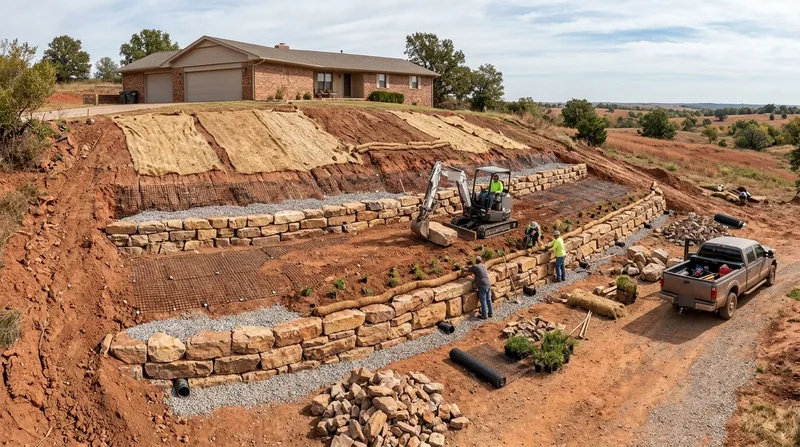




Oklahoma City's gently rolling red-dirt prairie, carved by creek ravines and wooded hillsides, creates ideal conditions for slope failure and erosion. Homes perched on the edges of the North Canadian River, Deep Fork, and Crutcho Creek watersheds, as well as those built on cut-and-fill subdivision lots in the Cross Timbers hills to the northeast, face constant pressure from slope stabilization and erosion control challenges. The expansive Permian clay that dominates Oklahoma City's subsurface swells dramatically during spring thunderstorm flooding and contracts during drought, cracking and shifting soil beneath driveways, yards, and home foundations. Winter freeze-thaw cycles accelerate the breakdown of unprotected slopes, while heavy downpours send runoff cascading across exposed earth, carving gullies and undermining retaining walls. Slope stabilization with terraced retaining walls, geogrid reinforcement, and erosion control protects your property, prevents costly foundation damage, and preserves the integrity of your landscape. We design and build stabilization systems that work with Oklahoma City's climate, soil conditions, and terrain to stop erosion before it reaches your home or driveway.
Why Slope Stabilization Matters in Oklahoma City's Creek Ravines and Hillside Lots
Oklahoma City's topography creates natural drainage patterns that concentrate water flow across hillsides and into creek systems. Properties in Heritage Hills, Mesta Park, Crown Heights, and newer subdivisions on the city's edges frequently sit on slopes that shed water directly toward foundations, driveways, and neighboring yards. Uncontrolled erosion on these slopes leads to foundation settlement, cracked concrete, undermined retaining walls, and loss of usable yard space. The red and brown sandstone ledge walls, segmental block borders, and aging railroad tie walls that hold back these slopes fail under the combined pressure of soil expansion, water saturation, and freeze-thaw stress. A properly designed slope stabilization system stops erosion at its source, protects your property investment, and eliminates the constant cycle of repair and replacement.
- We install terraced retaining walls that break long slopes into manageable segments, reducing soil pressure and water velocity.
- We deploy geogrid reinforcement behind wall faces to anchor soil in place and increase the wall's load-bearing capacity.
- We grade slopes at proper angles and install surface drainage to direct water away from your home and toward approved outlets.
- We stabilize creek banks and ravine edges with boulder and natural stone walls that resist undercutting and piping failure.
- We replace failed railroad tie and timber borders with engineered concrete or segmental block systems that handle Oklahoma City's climate.
These measures work together to arrest erosion, prevent catastrophic slope failure, and protect your property for decades.
Key info: Oklahoma City's Permian clay expands when wet and shrinks when dry, creating shear stress on unanchored slopes. A geogrid-reinforced retaining wall system resists this movement far better than a simple gravity wall, reducing the risk of failure in homes across Edmond, Norman, Moore, and the central Oklahoma City metro.
For detailed information on permit requirements and setback rules in your jurisdiction, consult the Oklahoma City Public Works Department or your local building authority, as thresholds vary by city and by wall height.
How We Stabilize Slopes and Control Erosion: Our Process in Oklahoma City
Slope stabilization begins with a thorough site assessment. We measure slope angle, soil composition, water flow patterns, and proximity to structures and property lines. We identify the failure mode driving erosion, whether it is piping along creek banks, saturation of expansive clay, or surface runoff across bare earth. We then design a multi-layered system that combines terraced walls, drainage, and erosion control fabrics to halt the problem. Our approach is site-specific and tailored to the local terrain, soil type, and climate stress that Oklahoma City properties face year-round.
- We conduct a free on-site inspection to evaluate slope geometry, soil stability, water movement, and existing wall condition.
- We design a terraced retaining wall layout and select materials, drainage, and geogrid reinforcement appropriate to the slope and soil.
- We obtain any required permits from the Oklahoma City building department or your local jurisdiction.
- We excavate the slope, set footing depth below frost line, and install drainage stone and perforated pipe behind the wall.
- We build the retaining wall face, backfill with engineered soil and geogrid, and compact in layers to specification.
- We grade the slope above the wall, install erosion control fabric or seeding, and establish proper surface drainage.
- We test drainage performance and make final adjustments to ensure water moves away from structures.
The result is a stable, durable slope that resists Oklahoma City's freeze-thaw cycles, clay expansion, and heavy rainfall events.
Local example: A home in Nichols Hills with a steep, eroding slope toward Deep Fork Creek had a failing 1970s landscape timber border and active gully formation. We installed a terraced two-stage segmental block wall with geogrid reinforcement, added a perforated drainage pipe at the footing, and graded the upper slope with erosion control matting. The property is now stable, drainage is controlled, and the homeowner has usable yard space again. See our retaining wall installation page for more details on how we build lasting systems.
Slope Stabilization Methods: Choosing the Right Approach for Your Oklahoma City Property
| Approach | Description | Best for |
|---|---|---|
| Terraced Segmental Block Walls | Multi-stage walls with geogrid and drainage, built to match subdivision aesthetics and handle expansive clay movement. | Moderate slopes in residential subdivisions, new construction, and retrofit jobs where appearance and durability matter. |
| Poured Concrete Retaining Walls | Monolithic cast-in-place walls with engineered drainage and reinforcement, built to withstand high soil pressure and freeze-thaw stress. | Steep slopes, tall walls, creek banks, and properties with high water table or saturated soil conditions. |
| Boulder and Natural Stone Walls | Red and brown sandstone or limestone ledge walls, mortared or dry-stacked, with geotextile backing and drainage stone. | Heritage lots in historic neighborhoods, creek ravine stabilization, and properties where natural materials match existing landscape character. |
| Erosion Control Fabric and Seeding | Biodegradable matting, hydraulic seeding, and native plantings that stabilize exposed soil and slow surface runoff. | Gentle slopes, areas above retaining walls, creek banks, and supplementary protection on newly graded surfaces. |
| Drainage and Subsurface Solutions | Perforated pipe, French drains, and positive slope grading that intercept water before it destabilizes the slope. | Saturated soils, high water table areas, and slopes failing due to water accumulation rather than angle or material. |
Each method is chosen based on slope angle, soil type, water conditions, and the specific failure mode affecting your property. We often combine multiple approaches for comprehensive protection.
Slope Stabilization and Erosion Control Cost in Oklahoma City: What to Expect
The cost of slope stabilization in Oklahoma City depends on slope length, height, soil composition, drainage requirements, wall material, and site access. A small terraced retaining wall system on a residential lot may cost significantly less than a multi-stage concrete system stabilizing a creek bank or tall hillside. Geogrid reinforcement, perforated drainage pipe, and engineered backfill add to material cost but are essential for durability in Oklahoma City's freeze-thaw and clay expansion environment. The best way to understand cost for your specific property is to request a free estimate from our team. We provide a detailed quote after an on-site assessment, so you know exactly what you are paying for and why. For a full overview of pricing across our service range, see our pricing page.
Factors that move the cost up include tall or steep slopes requiring deep footings, saturated soil requiring extensive drainage, proximity to structures or utilities requiring careful excavation, and material selection (natural stone and poured concrete typically cost more than segmental block). Properties in Moore, Midwest City, and Del City often face additional cost due to difficult soil conditions and water management needs. Getting 2 to 3 estimates from licensed, insured contractors is smart practice, as pricing and design approaches vary. Always verify permit requirements and setback rules with your local building department before committing to a design, as some jurisdictions require engineered drawings for walls above 4 feet or walls supporting a surcharge like a driveway.
Slope Stabilization and Erosion Control Near Me: What Oklahoma City Homeowners Should Know When Hiring a Contractor
Hiring the right slope stabilization contractor protects your property and ensures the work meets Oklahoma City code and performs for decades. Start by confirming that the contractor is licensed, insured, and bonded to perform retaining wall and grading work in Oklahoma. Get multiple estimates from contractors who will visit your site, assess drainage and soil conditions, and explain their design rationale. Check references from recent slope stabilization and retaining wall projects in Oklahoma City, Moore, Edmond, and surrounding areas, and ask specifically about how the work has held up through freeze-thaw cycles and heavy rain events.
Understand permit requirements in your jurisdiction. Many Oklahoma City neighborhoods, including Heritage Hills and Nichols Hills, have specific setback and property-line rules that affect wall design. Some HOAs require architectural approval for visible walls or material choices. Ask your contractor to handle the permit process and coordinate with your local building department, so you avoid costly delays or rework. Discuss drainage expectations, maintenance, and long-term care. A properly built slope stabilization system requires minimal upkeep, but understanding how to maintain drainage and inspect the wall annually will extend its life. Contact us at (405) 766-3551 for a free, no-obligation estimate and a detailed consultation on your slope and erosion challenges.
Slope Stabilization & Erosion Control in Oklahoma City: Pricing Guide
| Service | Price | Details |
|---|---|---|
| Small slope stabilization project | Free estimate | Terraced single-stage wall on residential lot with standard drainage, geogrid, and erosion control matting included |
| Medium slope stabilization system | Starting at $3,500 | Two-stage terraced wall, perforated drainage pipe, geogrid reinforcement, and surface grading on slopes 15 to 25 feet long |
| Large or complex slope stabilization | Starting at $8,500 | Multi-stage systems, creek bank stabilization, poured concrete walls, or saturated soil requiring extensive drainage infrastructure |
| Boulder and natural stone stabilization | Starting at $6,000 | Quarried sandstone or limestone walls with geotextile backing and drainage, tailored to heritage properties and historic neighborhoods |
| Travel and consultation | Included | No separate fee for travel within Oklahoma City metro; free on-site assessment and estimate within 24 hours of inquiry |
| Permit and engineering | On estimate | Tall or tiered walls may require engineered drawings; permit costs vary by jurisdiction and are quoted separately after design phase |
Indicative pricing, the exact cost depends on square footage, finish, and site access. Free personalized estimate within 24h at (405) 766-3551.


